
One interface for complex network operations.
UX/UI
USER RESEARCH
USABILITY TESTING
PROTOTYPING
DESIGN SYSTEMS
PRODUCT OVERVIEW
MY ROLE
I joined the product team to improve the existing user experience and help evolve the platform. Alongside ongoing UX improvements and design-system work, I took ownership of redesigning one core product area end-to-end, from user research and concept development through testing and implementation.
[CLIENT]
VODAFONE
[YEAR]
2023-2024
[ROLE]
UX/UI DESIGNER
[TEAM]
3 PRODUCT DESIGNERS,
4 FRONT-END DEV,
3 BACK-END DEV,
1 PRODUCT OWNER,
1 AGILE COACH
01 | THE CHALLENGES
Network workflows were still spread across multiple systems.
The platform already consolidated several tools, but users still relied on additional applications for parts of their day-to-day work
The challenge was therefore not to replicate every existing tool, but to identify which workflows created the most value inside one central experience
The product had grown faster than its design foundations.
Features had evolved with different layouts, components, spacing, and interaction patterns, making the overall experience feel inconsistent
Without a reliable single source of truth, both existing and new features became harder to design and scale consistently
Every new feature risked adding another layer of complexity.
Adding functionality through one-off solutions would have increased design debt and made the platform increasingly difficult to maintain
New workflows needed to build on reusable components, clearer information hierarchies, and shared interaction patterns
02 | KEY CONTRIBUTIONS
Redesigned the asset-management experience end-to-end.
The existing workflow separated file upload from metadata management, requiring users to edit images and videos individually after upload and making structured tagging cumbersome
I redesigned the experience across multi-file upload, single and bulk metadata editing, date selection, gallery interactions, and cover-image management
I validated the core workflow through stakeholder feedback, task-based usability sessions, and design critiques before moving into development
The redesigned experience was fully implemented and live before the end of my time on the project
Improved and explored core product workflows.
Worked on ongoing UX improvements across the existing product alongside the lead designer and product team
Explored a redesigned network-site dashboard to reduce information density, improve hierarchy, and apply more consistent interaction patterns
Used existing users and stakeholder feedback to understand where current workflows created friction and where improvements would provide the most value
The dashboard redesign remained exploratory during my time on the project and was not moved into development
Helped turn fragmented UI patterns into a scalable design system.
Together with the lead designer, reviewed the existing UI and identified inconsistent components, patterns, and foundations across the product
Helped define shared foundations for color, spacing, typography, radius, grids, shadows, and responsive behavior using the emerging token-based approach
Built and refined reusable components using variants and Auto-Layout instead of creating one-off solutions for individual features
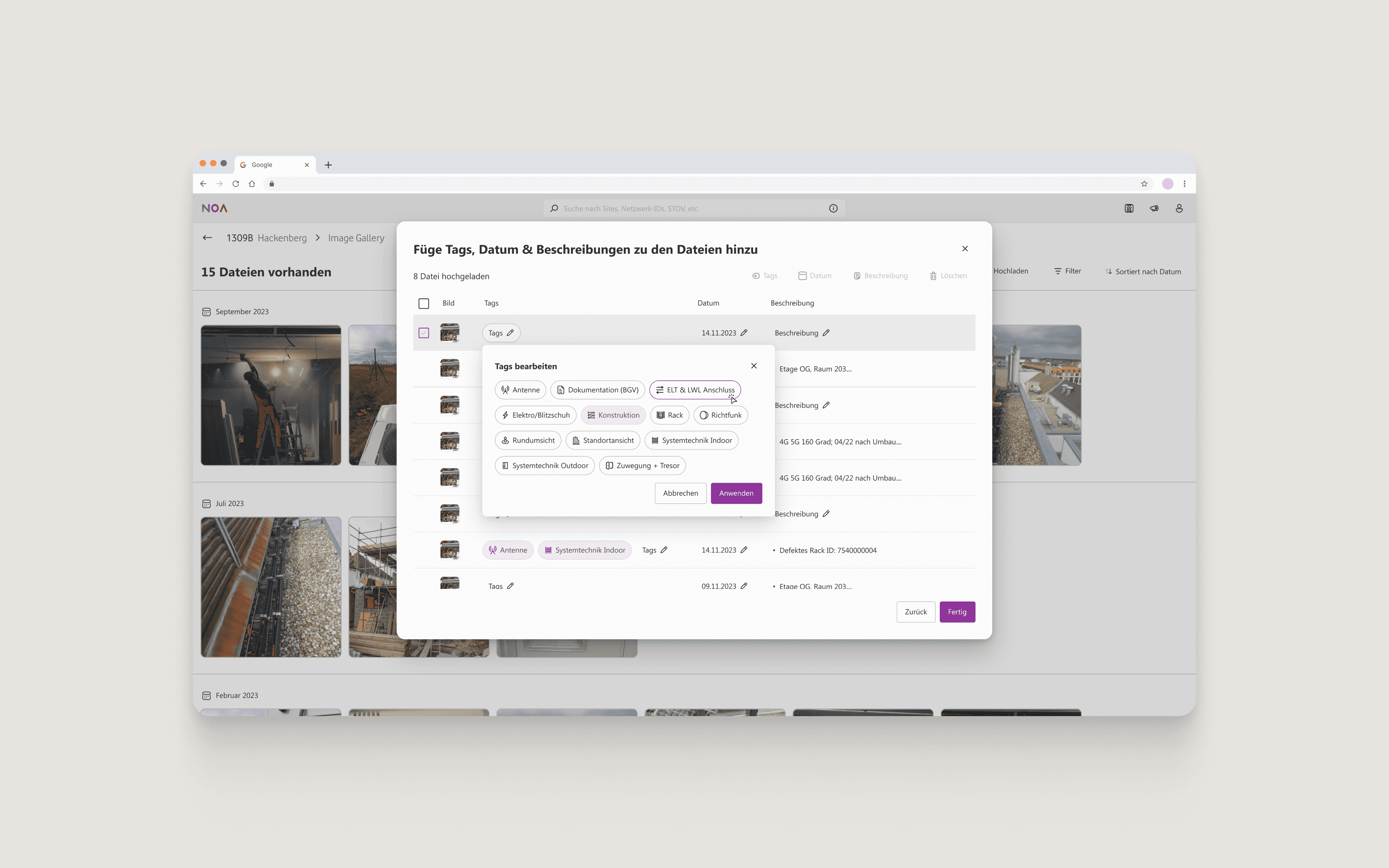
STRUCTURED METADATA MANAGEMENT
A redesigned post-upload workflow lets users add and edit tags, dates and descriptions across multiple site assets - individually or in bulk.

MULTI-FILE UPLOAD
Users can define a representative image for each network site directly from the gallery, making key visual information easier to identify

COVER IMAGE MANAGEMENT
Users can define a representative image for each network site directly from the gallery, making key visual information easier to identify.
03 |IMPACT & REFLECTION
The redesign moved from concept into the live product
The redesigned experience was fully implemented and live before the end of my time on the project
Core workflows had been validated through usability testing and stakeholder feedback before development
Since I left shortly after launch, I did not have access to long-term usage data or post-launch performance metrics
The new design system created a foundation for more consistent product development
The shared foundations and reusable components we introduced were adopted by the product team
Instead of designing features as isolated solutions, new interfaces could increasingly build on common patterns and components
The project changed how I think about scaling enterprise products
I learned that improving a complex product is not only about designing better individual screens, but about understanding how workflows, systems, and components connect
Working within an existing enterprise environment meant constantly balancing user needs with technical constraints and established processes
It reinforced the importance of close collaboration between Design, Product, and Development when moving work from research and concepts into a live product